Showing posts with label sailing. Show all posts

The Continuing Aventures of Boisterous


We have greatly enjoyed meeting other cruisers and making new friends. On the Rio Dulce, we were especially delighted to meet Hal and Marsha Haltom who have spent a year sailing (and climbing)with their three children, Travis 13, Haley 13, and Cameron 13. Yep, they're triplets! They cruise aboard "Cayuse" a Tayana 52. We were equally lucky to meet the Borthwicks aboard "Jireh," a 67' trawler. Brent and Sharon are are doing humanitarian/missionary work along with their children, Samantha 13, Justin 11, and Jessica 9. The group of us enjoyed parasailing,waterskiing, wakeboarding, and visiting a waterpark.


Going parasailing was one of the highlights for William and Henry. They launched off a dock at Mar Marine, and zipped up nearly 200' behind a Boston Whaler with a 115 hp outboard. Dangling from their harness they were able to see all the marinas and some of the small Maya settlements in the area. They flew for about 15 minutes and then landed in the water. I think they're ready to go again

Cruising kids at Rosita's restaurant on the Rio.


More cruising kids at Valle Dorado water park.

Pauli, enjoying a wet ride down a slide.
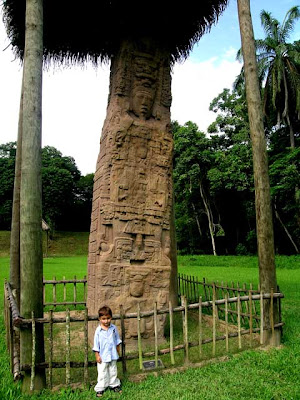

Lora particularly enjoyed visiting an ancient Maya ruin called Quirigua which was established more than 1,500 years ago. Although not as famous as Tikal or Coban, the Stelae here, carved from single blocks of stone, are among the best and largest anywhere. The tallest of them are around 35 feet high and weigh as much as 120,000 pounds.

The magnificent ceiba tree is the national tree of Guatemala. They can tower up to 230 feet.

While on the Rio we have been attending church at Morales, a town about 20 miles away.


Lora and I met a wonderful British couple, Christine and Bryan King who invited us to swim as their guests at the Catamaran Hotel. They have lived in Guatemala for around ten years. They have a historic 45' wooden boat "Mustang" which is more than 75 years old. It is beautifully maintained/restored.


Later they took to a Mayan village where they built a much needed clinic some years ago.
It took them and other volunteers over nine months to finish it. It is quite a place and impressively well-stocked with medicine and supplies.


At the village of Las Brisas, Christine is known as "Christina Vitamina" because of the nutrition program that she launched. She is also loved for the bags of treats that she brings with her to pass out to the children.


The village children were a little shy at first, but perhaps because we brought five boys of our own, or perhaps because of the candy, the kids were soon following us around and talking to us in Spanish and Q'eqchi. They showed us two litters of puppies.

This is fairly typical rain forest wear. Guys carry machetes everywhere, on bikes, on buses, in town. While we were in Las Brisas one man was brought in on a wheel barrow after accidentally cutting his foot with his machete.
This lovely woman was very shy and did not speak any Spanish. I believe that she had a single tooth. A major hazard for the Maya is that they cook inside their huts, and continually breathing the smoke from the fire is the equivalent of smoking 20 packs of cigarettes a day! Most of the floors were made of dirt.


Hilario is known for making sturdy dug-out cayucas from the San Juan tree. He offered to make one for me for about $300. He makes them by hand with just a small adze. Many of the Maya fish for a living because in some place the clay soil is not suitable for farming.

After visiting the village of Las Brisas, we took a tour at Casa Guatemala, a sad little orphanage.

Here Pauli poses is in the boys' dormitory. We were impressed with how neat this room was. At the orphanage there are currently about 180 children from 4 years old to 18. There are several volunteers that work and teach there. Our tour guide was Fawn Gibson from Salt Lake City, Utah.
The orphanage raises pigs to sell, and they are sometimes butchered on the property. They also raise and sell chickens and eggs. The children eat a lot of beans and rice, and they usually get one piece of fruit (often banana) and a bowl of mush for a snack.

In the past volunteers built tanks for hydroponics so that the orphanage could raise more of its food. Another group of volunteers built a system that makes electricity from pig dung, but the system is not currently in use.

One Saturday afternoon we decided to take a bumpy bus ride to Boqueron, a tiny town, where a river has carved a spectacular gorge about 400' deep and sometimes only about 40' wide.

We hired Hugo Chub to take us up the canyon in his dug-out canoe. Because this is the rainy season we had to paddle against a strong current. There are several caves along the way, and we saw some big bats.
We had to negotiate small rapids, logs, and boulders. At one point, he and and I both had to jump into thigh-deep water to push the 15' cayuca past a difficult spot.

The howler monkeys usually make a racket overhead. Moss hangs down from the trees which often span the gap between the cliffs. We would love to return.

Setting Sail

As we begin our year-long adventure, motoring out of Clear Lake and then sailing from Galveston Bay out to the Gulf of Mexico, I’m filled with concerns: Did I forget anything? Will our equipment work? Will we have mechanical problems? Will the weather hold up? It’s cloudy, and it rains intermittently, but everyone is in the cockpit and a little quieter than usual. Perhaps they are all deep in thought too. The motor hums along nicely. We’ve had so many minor problems with motors in the past that Lora and I are both a little paranoid. Anytime there is a variation in RPMs we both panic for an instant. Usually it just means someone bumped the throttle, sometimes it means that the fuel filter is clogging, but it could mean something serious.

Since we’re all very prone to sea-sickness, this time we are prepared: we’ve brought along Dramamine, Bonine, Transderm Scopolamine, and even suppositories for nausea and vomiting. We also have special battery-operated wrist-bands that deliver a little jolt of electricity to the inside of the wrist which helps minimize sea-sickness. There are five settings. I usually wear it on one. Lora is usually at two or three. At five, most people will cry uncle. In addition, Lora has packed ginger snaps, and ginger ale--reported to help with mal de mer.

Once in the Houston ship channel we hoist the main and motor-sail with the autopilot. We dodge tankers and freighters, and about five hours later we reach the long Galveston jetties. The waves are steep and scary and mean. We’ve never had such a rough ride. The boat is pitching and yawing and rolling but no one says anything. The black clouds look ominous, menacing. We’d be more wet if it weren’t for our new dodger and our big bimini.

No one is hungry, no one is talking, and in these conditions I know someone will throw up soon. That honor goes to nine year-old Warren, and he is followed by his younger brother Pauli. Though usually active and talkative, three year-old Parker lies quietly in his bunk. We unfurl the genoa and set our course for Cartagena Columbia about 2000 miles away. On deck we have strapped down six jerry jugs of extra diesel fuel (around 70 gallons), two jugs of water, and one jug of gasoline. In addition, the boat holds about 40 gallons of fuel and 100 gallons of water. Our 10’ Walker Bay sailing dinghy is strapped down on the cabin top which makes visibility difficult. We also have an 11’6” Avon inflatable in the cockpit locker. On the stern rail we have a 15 hp outboard motor and a 2hp outboard for the dinghies.

Although Lora and I had talked about William and Henry helping us stand watch at night, After about 11 p.m. everyone is asleep, and I’m left to stand watch alone. There are oil rigs all around us, and I scan the horizon every 15 or 20 minutes. It is exhausting, even though for decades I have stayed up late. The wind is around 15 knots, and we’re sailing along at about 7 knots. At dawn Lora comes on deck and relieves me, and I go below to get a little sleep before all the boys wake up.

I’m sea-sick for two days, but fortunately I don’t vomit. William doesn’t throw up either; everyone else does. On the morning of day three, I feel better, and am ready to eat. By the fourth day, I’m reading novels, and William is also well enough to eat. Pauli and Warren vomit the most. Lora gets sick a few times, but much less than on other crossings. She is using the electric shock watch, Dramamine, and the ear patch. After the second day there is less wind, and we often motor sail. At one point, our fuel filter clogs, and when I change it, there is a layer of gunk 1/4th inch thick which worries me. But after that one dirty filter, we have no more problems though we are consuming a little more fuel than we had anticipated. The next two days there is almost no wind. The sea is glassy calm as we motor along slowly burning up our fuel. On our three prior crossings we’ve either had no wind, wind on the nose, or too much wind. This trip is also falling into that pattern.

During the sea-sick period, William writes in his journal: “I promise myself, if I ever have a sailboat I will never go offshore. There is nothing fun, adventurous, cool, relaxing, romantic, or exciting about sailing offshore.”

Lora is often busy with Parker, and so William has really taken over the role of first mate. He helps me raise and lower sails, and he stands watch during a great part of the day. One memorable and miserable night our mizzen sail rips, our genoa sheet breaks, our main halyard jams, our windvane starts banging against the hull, and our running lights short out. We deal with it the best we can and then motor under bare poles. It’s 3 a.m. before William and I finish securing things.

When we left Galveston, we saw a cruise ship named Ecstasy also heading out. We could actually smell their dinner cooking. Four days later we saw the same ship heading back to Galveston after visiting Progreso. We later learned that when these ships are close by, you can usually get your cell phone to work.

I’m a little discouraged at our progress, and a little disappointed with myself for not bringing more fuel along, but then in the afternoon, a school of dolphins comes alongside swimming and jumping and seeming to enjoy themselves and our company. We all go to the foredeck to watch these graceful creatures, and after their show we are all cheered. And then the wind picks up. After that, the pattern is 20 knot winds at night, and 10 knots during the day. Unfortunately the wind is from the direction that we want to go; we’re low on fuel, and we have some things to fix on the boat, so after some discussion, we decide to alter course for Progreso, Mexico, about 130 miles west of Isla Mujeres, but even on this heading we can barely sail our course.

One day William and Henry try fishing, but after only catching Sargasso seaweed and after loosing one of our precious lures, they both retire. Too bad, fresh fish would be a nice change from cup-o-noodle, granola bars, or peanut butter and jelly. One night Lora actually fired up the stove and made macaroni and cheese, and that was a huge hit.

One pleasant surprise is that a $200 autopilot that I bought at a nautical swap-meet has worked flawlessly. We’ve hardly had to touch the wheel. These units retail for $1200, and although we had one on a previous boat, it often gave us trouble, especially under sail, but this one has worked so well that we haven’t even bothered using the Monitor windvane that we installed prior to departure.

It was usually hot and humid inside the boat, and during a calm when Lora opened an overhead hatch, Parker said, “Oh good, the AC is on.” William and Henry who sleep up in the v-berth got their bunks soaked through a dorade vent—that’s discouraging. Although we rebedded most of the port-lights, some of them still leak.

Our new roller-furler has worked perfectly. The Single Side Band radio however was a big expense, and so far it has been a disappointment. We hope that later someone can help us find the problem so that we can use it to get weather information while underway.

After seven days, we arrive at Progreso at dusk. Most of our clothes and bedding is dirty or wet. The boat is covered with salt. We’re out of vegetables and fruit, so we’re eager to set foot on land. Instead the boat hits bottom in the channel going in the small jetties, and then about 100’ from the fuel dock at the marina we run hard aground again. Odd, because we’ve been here on two previous occasions, but it turns out that we have arrived during a very low tide. An hour or so later, a guy in a powerboat takes a line from our boat to the fuel dock, and we are able to use the sheet winch to pull ourselves to the dock. Whenever there is a lull in the wind, we have to swat mosquitoes.

The next day we go in search of a marina, and it is the busy season so we have trouble finding a slip. The immigration people come to our boat and we clear in after paying the fees at a bank in town. The boys quickly go in search of marine-life to terrorize, and soon they come running back to the boat to show off a big crab that they’ve caught.

The marina has no electricity at the docks, but they have wonderful restrooms, and a warm shower feels great. We take a “combi” van into town and have dinner at one of the oldest restaurants. Lora and I do e-mail, and then we walk to the beach. On the way home we buy groceries. We’re all craving fresh fruit.

The boys are wide-eyed as they see how some of the locals live. Although there are a few nice houses, we see many shacks and huts, some made out of tar paper and some made out of sticks. The roofs are probably made of palm thatch, and there is a lot of trash everywhere. We see several families of four riding on one rusty scooter.

While in Progreso, William turns 14 years old. Ironically, 10 years before he turned 4 in this same town, so we take him to the same pizza place, and he says he remembers it. Back then I had bought him a cap gun which he enjoyed. It would be nice to stay a few more days, but the marina is expensive, and we still have a lot of miles to sail, so after three days we sail to Isla Holbox where we run aground trying to get into the lagoon. We just throw the anchor over the side and spend the night in 4.5 feet of water. Our boat draws 6 feet.

Next installment: Isla Mujeres.